Image
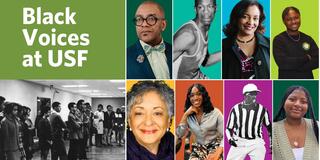
February of 2026 is the national centennial of Black History Month, marking 100 years since Dr. Carter G. Woodson initiated the original week-long observance in order to promote the study of Black history.
USF’s Professor James Taylor is an expert in many areas including African American political history, social movements, law and public policy, and race and ethnic politics. On the subject of the Black experience at USF — how the past influenced the present Black community, he invoked the life and legacy of Dr. Patricia Hill MA ’70.
“She was foundational in knocking down ceilings in order to get better representation for Black staff and faculty,” said Taylor. “And today, Black individuals are well-represented across the university, across the schools and colleges, the campus, and the student body.”
He acknowledged that there is duality in the experience of being an ethnic minority in a space like USF, but that he feels like the university has taken steps, especially in the past 10 years, to create a positive experience. Taylor said, “This track is developmental and positive. USF is on the right side of this moment with regard to diversity, supporting students, and helping Black students and Black alumni flourish.”
Taylor also referenced the fact that USF’s current Black-identified student population, at 13.2 percent, is proportionally double that of San Francisco and California as a whole, but it wasn’t always that way.
In 1930, Isaiah Fletcher ’32, a football player, became the first African American varsity student-athlete at USF. Since then, Black voices, activism, and athletics have a long history of interconnectivity on the Hilltop.
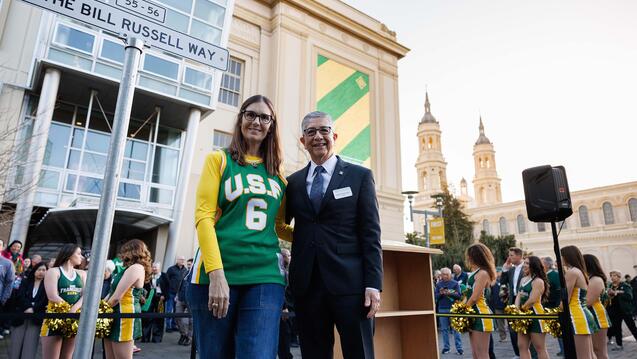
The legendary Bill Russell ’56 is a prominent example. Throughout his life, he advocated for social justice and human rights. Russell will be honored on the Hilltop with the inaugural Bill Russell Impact Classic on February 12, 2026.
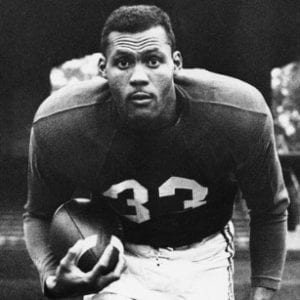
Another well-known example is the famed 1951 football team, who collectively refused to play a bowl game without their two Black teammates, Ollie Matson ’52 and Burl Toler ’52.
USF renamed a residence hall in honor of Toler — who went on to become the first black official in any major professional sports league — in 2017.
USF’s Black Student Union
On April 4, 1968, when Dr. Martin Luther King Jr. was assassinated, Trustee Emerita Adrienne Riley, ’71 MA ’74, a founder of USF’s Black Student Union (BSU), was on campus, gathering with classmates near present-day Toler Hall.
“We, as a group of students, gathered there just trying to comfort each other in the grief we had. And right then we started to form the BSU,” said Riley.
Trustee Emeritus Dr. Joseph Marshall ’68 was the BSU’s first president, and remains a powerful voice for social justice, nationally.
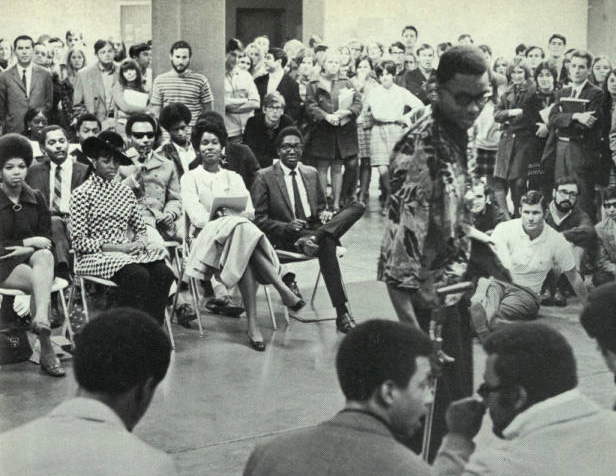
“Student activism was thriving all across the country,” said Riley. “We were standing on the shoulders of things that are now in history books like Martin Luther King, John Lewis and the Freedom Riders, and A. Philip Randolph.”
In 2018, USF launched the Black Achievement Success and Engagement initiative (BASE), to help Black-identified students at USF create community and access resources.
Undergraduate student Kaylee Wright ’26 said, “It can be a bit of a shock, especially for students that come from predominantly Black areas like myself. I almost transferred out, but I really relied on the Black staff and community here, specifically under BASE.
“BASE provided the best internship I’ve had, and I helped convince a lot of other students to come to school here — but I was always honest with how I felt. It can be a twofold thing.”
Students, faculty, and administrators point to BASE as a differentiator, influencing the growth of USF’s Black-identified student population to 1,160 undergraduate and graduate students.
Professor Pamela Balls Organista, a co-founder of BASE, said, “I get excited when we’re recruiting students and they say, ‘I wanted to be at this university because of this program — I’m seen, I’m being supported here, and I belong here.’”
President/Chair of the Black Graduate Student Association (BGSA), Emonee Richard MA ’26, said that her role, “puts such a smile on my face, because a graduate program is already stressful and then you layer that with potential loneliness or isolation from not having community in a more dominant white space, demographically.”
Fellow graduate student Benson Adomako MSc ’26, originally from Kumasi, Ghana, is the vice president of BGSA. He says that collaborating with Black Alumni Society (BAS) members, with BASE students and staff, and the availability of student support resources have all helped him feel at home at USF.
“We helped mobilize Black graduate students, making sure that we're engaging students on campus from the time they arrive.
“There's also the Black Resource Center and the school is very intentional, and it makes it very inclusive.”
Learn how you can make a difference during the Black History Month centennial.