Image
The University of San Francisco is shaped by women who stepped forward as pioneers, leaders, and champions.
Founded in 1855 as an all-male institution known at the time as St. Ignatius Academy, USF became fully coeducational in 1964. Lone Mountain College for Women, established by the Religious of the Sacred Heart in 1932, merged with USF in 1978, further expanding opportunities for women at the university. Today, the Alumnae of the Sacred Heart honor the legacy of Lone Mountain through philanthropic support and stewardship of the Lone Mountain campus.
These five defining moments celebrate the trailblazers who continue to inspire generations of Dons.
When St. Ignatius College, the former name of USF, first admitted women to night classes in 1927, many students were skeptical of the new additions to the historically all-male college. The following year, the College Players welcomed women to the stage, casting actresses in their production of The Rivals. The Ignatian described the decision as an “innovation,” capturing the excitement and possibilities that came with representation.
In 1964, a headline in the San Francisco Foghorn captured a moment of profound change: “Feelings run high — Coeds invade USF.” The story detailed a mix of boos, catcalls, and a few isolated cheers from some students who saw the university's decision to become fully coeducational as a threat to its character. They could not have been more mistaken. Then-president Rev. Charles Dullea, S.J., observed that the women students quickly distinguished themselves as top academic performers so much so that male classmates jokingly dubbed them the “DAR,” or “Damned Average Raisers.” The nickname revealed a deeper truth: women raised the bar for everyone.
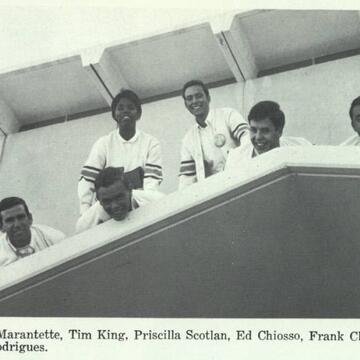
In 1927, as USF first opened its doors to women, a cynical voice in The Ignatian questioned the impact: “Oh, will it come to this—a yell leader of the other sex?” Forty years later, Priscilla Scotlan ’68 provided the answer with a megaphone, rallying for Don's spirit for everyone as a standout member of the first coeducational graduating class. Nowadays, the Priscilla A. Scotlan Career Services Center continues her legacy of support for trailblazers.
Immediately following the assassination of Dr. Martin Luther King Jr. in 1968, a small group of Black students gathered and forged a powerful commitment to form a Black Student Union (BSU) at USF. Among them was student leader and Trustee Emerita Adrienne Riley ’71, MA ’74, along with other BSU advocates who gained milestone achievements such as the first Black studies program. Their work was pivotal to USF's continuing support for Black students, such as the Marshall Riley Living Learning Community and Black Achievement Success and Engagement initiative (BASE)
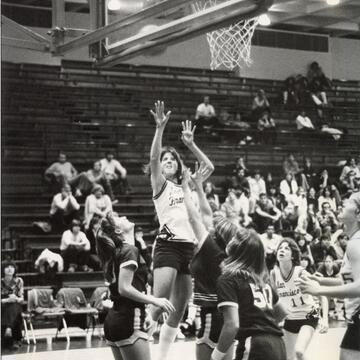
On January 29, 1981, Mary Hile-Nepfel made history, breaking records at a time when women's athletics were fighting for equal footing. With a single basket against UC Santa Barbara, she scored her 2,117th point, surpassing the legendary Bill Cartwright, and became the all-time leading scorer in USF basketball history.
Later that year, her jersey was retired, making her the first female athlete at USF to receive that honor. Five years later, she broke the ceiling and became the first woman inducted into the USF Athletic Hall of Fame.
From the first women to step into night classes to the leaders, athletes, and changemakers who followed, each moment has pushed the university forward.
Continue to shape the legacy of women's history at USF through the Women in Leadership & Philanthropy network.